


No products in the cart.
Return To ShopFinger painting: what it is, history, technique, and famous finger painters
When most people hear “finger painting” they picture children with hands smeared in tempera. The association is true, but incomplete. Finger painting is also an adult painting technique with a history that spans millennia — from the cave paintings at Lascaux to contemporary galleries in Brooklyn — and is enjoying a small renaissance today thanks to a group of artists who have decided to abandon brushes and physically reconnect with the canvas.
This guide explores what finger painting actually is as adult art: its history, how the technique works, the contemporary artists practising it seriously (including the work of Keili Major, an Estonian painter with a studio in Garessio, Val Tanaro, in north-west Italy), and how to get started — whether you want to commission a piece or learn the technique.
What finger painting is
Finger painting is a painting technique where colour is applied directly with the fingers, hands, and occasionally palms — no brushes, no palette knives, no traditional tools. The technique can be used with various media: tempera, watercolour, acrylic, soft pastels, and — in its most ambitious gallery-grade form — with oil paint on canvas.
Oil on canvas is the most demanding territory for adult finger painting. Oil is a dense, slow-drying, viscous medium. Worked with brushes, it lets itself be controlled predictably; worked with fingers, it requires the artist to handle paint like sculpture — feeling resistance, the right pressure, how much paint to pick up. Each finger becomes a different tool: the thumb makes broad gestures, the pinky chases details, the fingernails scratch fine textures.
A long history of hands on paint
The origins: cave paintings
The first documented forms of finger painting date back to the Upper Palaeolithic. In the caves of Lascaux (France, ~17,000 years ago), Altamira (Spain, ~36,000 years ago), and Cueva de las Manos (Argentina, ~9,000 years ago) you find handprints and finger-painted marks made with red ochre, manganese, charcoal. They were ritual, communicative, identifying gestures — long before brushes existed.
The 20th century: from school craft to avant-garde gesture
In the early 1900s, finger painting enters Western schools as an educational tool for children — particularly through the work of Ruth Faison Shaw, an American educator who in the 1930s develops a specific “method” and patents non-toxic finger paints. From here comes the popular association between finger painting and childhood.
In parallel, some adult avant-garde artists experiment with painting without brushes as a liberating gesture. Wassily Kandinsky made some experiments with fingers; later, American action painting (Jackson Pollock, Willem de Kooning) and French art brut (Jean Dubuffet) recover the idea that painting can do without tools — though in different ways from technical finger painting.
The contemporary revival
Finger painting as serious adult practice returns to prominence in the 2000s thanks to a group of artists reclaiming its legitimacy as a gallery-friendly technique. The most prominent case is Iris Scott (American, b. 1984), who paints with surgical gloves and oil on large canvases and has built an international audience through social media and Brooklyn exhibitions. Other contemporary practitioners: Judith Braun (charcoal with fingertips, USA), Zaria Forman (hyperrealistic pastels of polar landscapes), and — in Italy — Keili Major, who works with oil on canvas in Garessio.
Famous finger painters
Who are the best-known finger painting artists working now? A short list, by medium:
- Iris Scott (USA) — oil on large canvases, worked with surgical gloves. The artist most associated with the term, with an international collector base.
- Paolo Troilo (Italy) — monumental black-and-white acrylic figures painted with the fingertips.
- Chiara Magni (Italy) — colourful oil finger painting in an impressionist key.
- Judith Braun (USA) — large symmetrical wall drawings made with charcoal on the fingertips.
- Zaria Forman (USA) — hyperrealistic pastels of glaciers and oceans, blended by hand.
- Keili Major (Estonia; lives in Garessio, Italy) — oil on cotton canvas applied with the fingers, from still lifes to the year-long river cycle Anno Tanaro.
Finger painting technique: how it works today
Materials
- Primed oil canvas, usually high-quality (cotton or linen with primer). Finger painting tends to use medium-to-large formats (50×60 cm and up) because fingers are “thick brushes”: fine details are difficult below 40 cm.
- Tube oil paint, traditional or water-mixable. The water-mixable variety is gaining popularity among finger painters because it avoids toxic solvents (turpentine, white spirit) — a meaningful factor when working in direct contact with skin.
- Surgical gloves (optional). Some artists use them for protection and to change the “feel” of finger on canvas. Others prefer direct contact.
- Palette — often larger than usual, since you work with bigger amounts of paint at a time.
- Linseed oil or medium to adjust viscosity.
The work process
A typical finger painting session on oil canvas follows these phases:
- Preparatory sketch — on canvas or paper, to fix the composition
- Underpainting — first layer of colour, often monochromatic, to establish light and shadow values. You’re already working with fingers here
- Colour layers — successive layers, each applied after the previous has dried sufficiently. Oil takes time: 3-5 days for a thin layer, up to two weeks for a heavy layer
- Details and finishing — final layers chase fine details with fingertip or fingernail. Texture, reflections, highlights
- Full drying — weeks before you can ship or varnish. Oil doesn’t really “dry” but polymerises — the chemical bond continues for months
The technical signatures
An oil-on-canvas finger painting can be recognised by several traits:
- Visible finger marks in colour areas — small parallel lines left by fingertips
- Richer texture than standard brushwork — the finger accumulates paint differently
- Soft edges between colour zones — brushes tend to make crisp edges, fingers soften
- Three-dimensional materiality — paint “rises” off the canvas more visibly, especially in light areas
Why finger painting as adult art
Those who choose finger painting as a serious technique do so for various reasons. The most recurring:
Physical connection with paint. The brush is a mediator — the tool that stands between artist and canvas. Fingers eliminate it: the artist feels the paint — its resistance, density, temperature. It’s a direct physical relationship, with no tool in between.
Textures impossible with brushes. Human skin works paint in ways brushes can’t. The parallel fingertip lines, soft buildup at edges, the ability to “sculpt” paint as you apply it — all specific characteristics.
Intuitive speed. Without the “pick brush, wash, change colour” steps, the flow is more direct. Many finger painters say the technique suits subjects that demand spontaneity — quick landscapes, first sketches, life work.
A new relationship with edges. Few techniques offer the freedom of finger painting in modulating gradients between two colours. Fingers can “blend” zones organically, without the rigidity of contours.
Examples: the work of Keili Major
To make the technique concrete, three examples from Keili Major’s portfolio — Estonian finger painter based in Garessio, Val Tanaro, with a permanent exhibition at La Fabbrica del Cotone restaurant:
“Tanaro” (95×95 cm, 2026) — A large finger painting of the Tanaro river at Garessio after a snowfall. The fingers handled water reflections, snow on branches, mountain shadows. An exemplar case of how finger painting can render multiple textures (water, snow, rock, vegetation) within a single piece.
“Forest walk” (60×73 cm, 2025) — A traditional realistic oil painting (not finger painting), included here for contrast: same artist, same mountain scene, but with brushes. Seeing them side by side, you immediately understand what finger painting does differently.
“Magic mushrooms” (50×40 cm, 2021) — A fantastical composition with luminescent mushrooms on a forest ground. Finger painting here expresses its full “narrative” quality: visible finger marks in the wood, intense paint buildup on the mushrooms, soft gradients between light and shadow.
Anno Tanaro: a year of finger painting on one river
Keili Major’s current project shows what the technique can do over time. Anno Tanaro is a cycle of twelve finger paintings, one per month from June 2026 to May 2027, all of the same point on the Tanaro river at Garessio, all 60×80 cm, oil on cotton canvas. Each month the spot is photographed in the same light, and she paints the canvas from that reference — the river changes, the method does not.
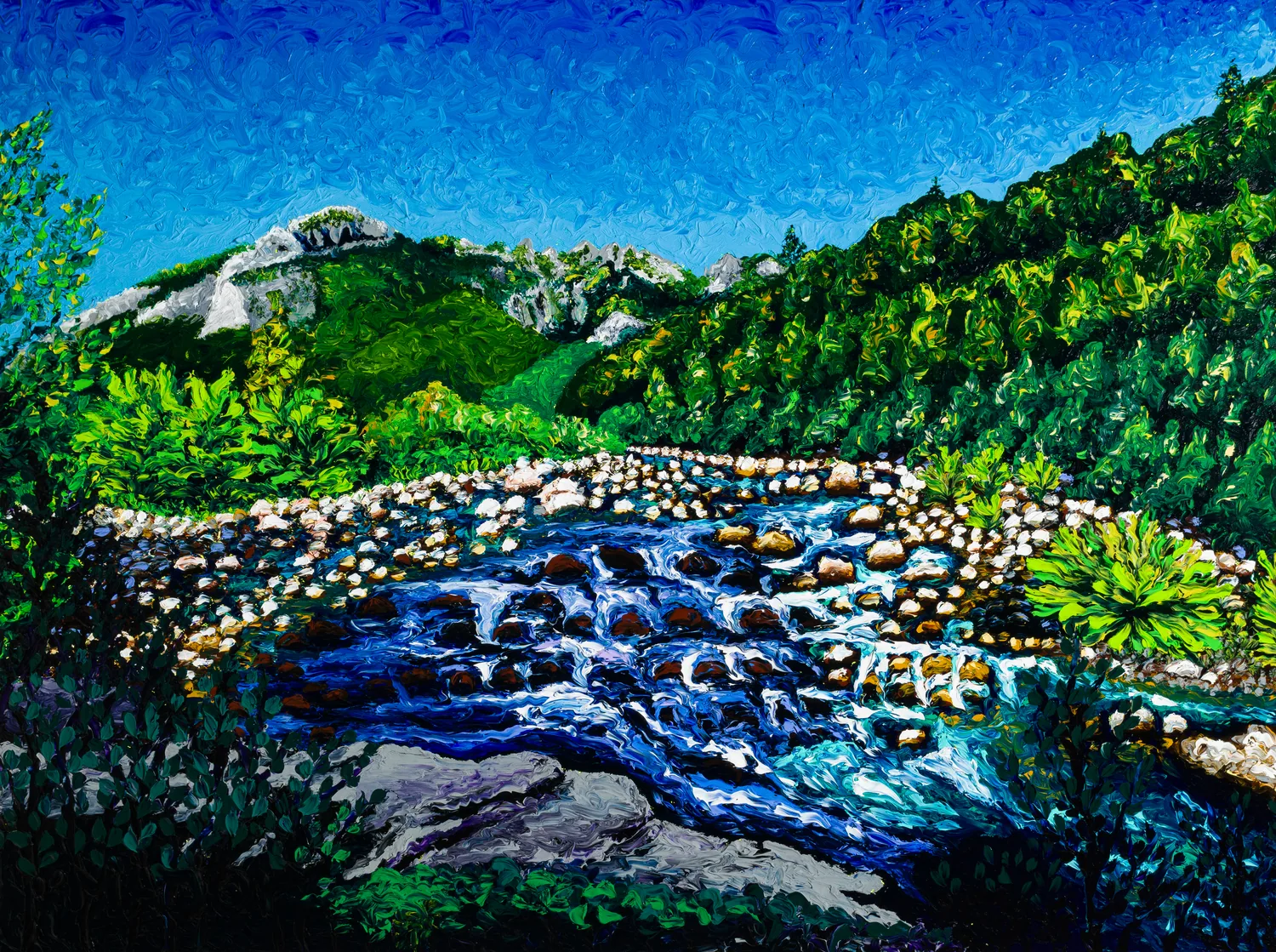
The first two paintings are public: Tanaro I (June) and Tanaro II (July).
Finger painting vs traditional realistic oil
| Finger painting | Traditional oil | |
|---|---|---|
| Tool | Fingers, palms | Various brushes |
| Edges | Soft, blended | Sharp if intended |
| Texture | Fingertip lines, material | Uniform brush stroke |
| Maximum detail | Limited (down to ~5 mm) | Very fine (single hair) |
| Time for medium piece | 3-6 weeks | 6-12 weeks |
How to start with finger painting
For those wanting to explore the technique, options depend on the goal:
To try for the first time: all you need is water-mixable oil paints (a basic set costs €30-50), a primed oil board, and a pair of gloves if you don’t want to get dirty. You can start painting without any course. The technique is almost more intuitive than the brush — what’s hard is developing control.
To learn seriously: Keili Major teaches private lessons in finger painting at her studio in Garessio, for both adults and children, from beginner to advanced level. Lessons last about 2 hours and include materials. You start from the basics (how to “read” colour with fingers, how to handle drying time, how to switch colours) up to complete personal projects.
To commission a piece: if you don’t want to learn but would like a finger painting, Keili works on commission. Full price details in the 2026 pricing guide and the process in the 7-step process guide.
Frequently asked questions
Is finger painting a real art form?
Yes. Handprints and finger-drawn marks are older than brushes — Lascaux, Altamira, Cueva de las Manos — and today oil finger paintings hang in galleries and sell to collectors. “Finger painting” covers both a children’s activity and a demanding adult oil technique; this page is about the second.
What does a finger painter actually use?
Oil paint on primed canvas is the most common serious setup. Some artists wear surgical gloves, some work bare-handed; fingertips, knuckles and nails each leave a different mark. Acrylic, pastel and charcoal versions of the technique exist too.
How is a finger painting recognised?
Look for parallel fingertip lines in the colour fields, soft edges between zones, and paint that rises off the canvas in relief. Under a raking light the marks are unmistakable.
Learn more
- Portfolio — Keili Major’s complete works gallery, by technique
- Permanent exhibition — La Fabbrica del Cotone, Garessio (Italian Alps), 9 works free to visit
- Private lessons — finger painting courses for adults and children
- Custom Art — finger painting commissions on oil canvas
Keili Major is an Estonian painter based in Garessio, Val Tanaro (Italy). Her signature technique is finger painting: oil on canvas, applied with the fingers.

Add comment